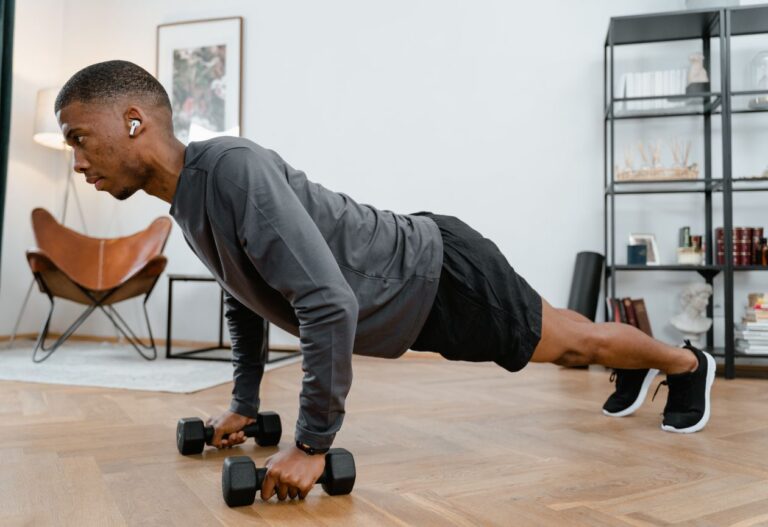
For years I was convinced building muscle required a gym — the membership, the machines, the mirrors, the blokes grunting in the corner like volume was a training method. Then a baby, a mortgage and a diary with zero white space ended that idea, and the gym became a daydream I had during night feeds.
So I shoved the coffee table against the sofa, cleared a patch of living-room rug, and trained with nothing — no bench, no bands, not even a mat at first. My daughter watched from her bouncer like it was children’s telly. It worked, which annoyed me, because I’d spent years assuming it couldn’t.
Here’s the mechanism nobody explained to me: muscles don’t know what a dumbbell is. They know tension, tiredness, and being asked for slightly more than last time. A barbell delivers that one way; your bodyweight delivers it another — free, and always with you.
Five moves was my whole programme
For four months I did exactly five exercises: push-ups, squats, lunges, glute bridges, planks. The list looked embarrassingly short on its sticky note. But a slow push-up — three seconds down, pause at the bottom — humbles people who throw barbells around with sloppy form. I spent weeks fixing my squat because my knees caved in like a folding chair.
Make it a little harder, every week
I nearly went wrong here: for a while I repeated the same comfortable routine, and nothing changed. Muscles are lazy like that. The fix is unglamorous — keep raising the challenge a notch. I went from knee push-ups to full to diamond to archer over most of a year; each jump felt like starting over. Squats became split squats, then Bulgarian split squats, which I moan about constantly.
Eat like you want to grow
My biggest mistake cost me a year. I trained consistently for twelve months and looked exactly the same, because I ate as if the workouts didn’t count. Muscle needs material — around 1.6 to 2.2 grams of protein per kilo of bodyweight daily — and enough food overall that the scales creep up. Once I ate properly, everything finally moved.
Sleep counts as training
Muscle is built between sessions, not during them. I train two or three times a week, sleep seven to nine hours, and take proper rest days. Soreness was never the goal; progress was. The month my sleep got consistent, my push-up numbers jumped by a third.
You don’t need permission or equipment to start — just a patch of floor, five moves, and the patience for one more rep than last time. Twenty minutes today is a real start. A year from now you’ll wish you’d begun sooner.
Your Flat Is Already a Gym (Mine Was, Apparently)
Question: what did you walk past this morning that could make your push-ups harder?
For me it was the hallway. Six metres of it. I’d do ten push-ups every time I crossed it, which sounds insane until you realise I cross that hallway maybe fifteen times a day. That’s 150 push-ups before dinner, none of them hard enough to ruin me, all of them quietly adding up. My wife thought I’d lost it. My chest disagreed.
The rule that makes this work: every set stays easy. Eight reps when you could do twenty. Stop with plenty left. You’re not training — you’re rehearsing. The movement gets smoother, the numbers climb, and your weekly volume doubles without a single “workout”. Kettle-boil squats. Microwave lunges. Doorway rows on the frame (test it first — mine held, my mate’s didn’t, and his landlord is still annoyed). Twenty honest minutes plus a day of sneaky sets beats one heroic Saturday followed by six days of nothing. Every time.
Raid the Kitchen, Not the Shops
Nobody needs to buy equipment. My “weight vest” was a rucksack full of hardbacks — Dostoevsky is surprisingly heavy, who knew — until the strap gave out mid-lunge and Crime and Punishment went sliding across the kitchen floor. My wife laughed for a week. I deserved it.
What actually works, tested by my own clumsiness: a rucksack of books for push-ups and squats (check the zips first, learn from me). A dining chair for dips and Bulgarian split squats — back foot goes up on the seat and you will immediately understand why people hate these. The stairs for calf raises; stand on the edge of the bottom step, slow lowers, and try walking normally the next day. A towel looped around a closed door for rows, but — and I cannot stress this enough — lean back gently first. “Feels solid” and “is solid” are different things, and doors are expensive.
Start stupid-light. Test everything. The house becomes a gym and the only membership fee is the occasional book avalanche.
Film It. Delete It. Get Better.
Mirrors are liars. The moment you look, your form changes — chest up, chin in, performing for yourself.
So once a month I do this: phone balanced on the shoe rack, film one set of squats, one set of push-ups, watch it back immediately. First time, I was horrified. My “deep” squats were knee-bends. My push-ups had a hip sag you could park a bike under. One three-minute video fixed more than six weeks of me confidently doing it wrong.
Nobody sees the footage. It’s not content. Delete it the same day. But do it on a schedule — first Sunday of the month, same two moves — because comparing this month to last month is the most honest progress photo you’ll ever take. No filter survives a side-view squat.
[…] equipment? Also fine — this bodyweight workout guide has bodyweight swaps for […]