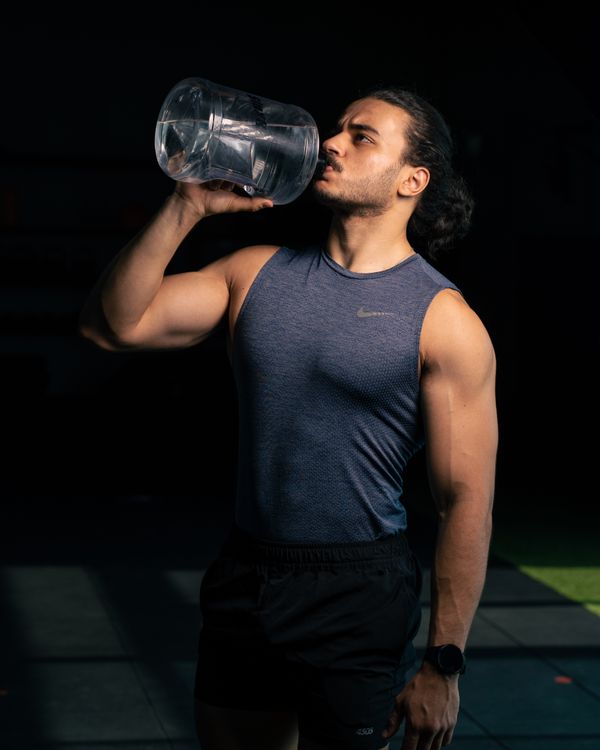
I used to think drinking water during workouts was for soft people. Genuinely. First year of training, I’d walk in with a Nalgene I’d filled sometime last Tuesday, take two sips out of guilt, and then grind through the session running on spite and pre-workout. My 6:40 alarm sessions felt okay. My 5 p.m. sessions felt like someone had replaced my blood with warm gravy.
Took me embarrassingly long to connect those dots. Turns out dragging yourself through a workout mildly dehydrated doesn’t build character. It just makes you weaker, slower, and dumber — measurably. Even the kind of dehydration where you don’t feel thirsty yet will shave real percentages off your strength and endurance. Scientists have measured this. I measured it by nearly passing out during a set of Bulgarian split squats in July, which is less rigorous but more memorable.
So how much water do you actually need? The real answer is annoying in a different way than you’d expect: simpler than the fitness internet makes it, but the famous rule everyone quotes is garbage.
The 8-glasses rule is garbage
Eight 8-ounce glasses. Two litres. You’ve seen it on infographics with watercolour lemons. Here’s the thing nobody mentions: nobody can find where it came from. No landmark study. No committee of serious people in lab coats. It survives because it’s catchy, the same way “breakfast is the most important meal of the day” survived (that one was invented by a cereal company, by the way — John Harvey Kellogg’s people, 1917, look it up).
One number cannot serve a 55 kg woman doing Tuesday yoga and a 95 kg guy deadlifting in a garage in August. Different bodies, different sweat rates, different food, different weather, different training. A single magic number is a slogan, not advice. And slogans don’t hydrate anyone.
Numbers, since you asked (fine, there are some)
The U.S. National Academies put total daily water around 3.7 litres for men and 2.7 for women. Key word: total. That includes food. Cucumbers are basically crunchy water. So are watermelon, oranges, soups, cooked rice, oatmeal. Somewhere between a fifth and a third of your water shows up on your plate without you doing anything clever.
For training specifically, the American College of Sports Medicine — actual sports scientists, not Instagram — suggests roughly 500 ml (two normal cups) in the 2 to 3 hours before you train, then 150 to 350 ml every 15 to 20 minutes during. After, the guideline is about 1.5 litres per kilo of bodyweight lost. Which sounds insane until you do the grim little experiment: weigh yourself before and after a hard session. I did this last summer after an hour of lifting in a gym whose air conditioning had given up. Down 1.4 kg. That’s over two litres of fluid gone, and I’d drunk maybe half a bottle. No wonder I felt like hell.
Don’t turn this into homework. These are starting points, not commandments. Your body reports back better than any formula — which brings us to the test that costs nothing.
Piss check. Yes, really.
Pale straw? You’re golden. Dark yellow, looks-like-apple-juice? Drink water, you raisin. Completely clear, all day, every day? Weird flex, but you might actually be overdoing it (we’ll get to that).
And thirst — for years everyone parroted that “by the time you’re thirsty, you’re already 2% dehydrated and basically dying.” Dramatic. Overstated. Thirst is a perfectly decent early signal for normal life. It only lags behind reality during genuinely hard exercise in real heat, which is why long hot sessions deserve an actual drinking plan instead of vibes.
Oh, and the one nobody told me: the 4 p.m. crash. For months I blamed my afternoon headaches and brain fog on bad sleep, screen time, Mercury in retrograde, everything except the obvious. Then one Tuesday I drank a big glass of water on a whim at 3:45 and felt human by 4:15. Thirty minutes. Free. I was furious at myself. If your energy falls off a cliff every afternoon for no reason, run the cheapest experiment in fitness before you buy supplements.
Tuesday. Leg day. 38 degrees. A cautionary tale.
Timing matters, and I learned it the wet way. Chugging a full litre ten minutes before squats is how you discover what sloshing feels like from the inside. Nausea during set three. Lesson learned, never repeated.
What actually works: in the 2 to 3 hours before training, drink around 500 ml alongside your normal food. Arrive hydrated; don’t try to catch up mid-session. During sessions under an hour in normal conditions, small sips every 15 to 20 minutes — 150 to 250 ml a go. Over 90 minutes, or anything in genuine heat, step it up and get some sodium in you. Plain water replaces fluid. It does not replace salt. Your sweat is salty for a reason, and no, “just drink more water” doesn’t fix cramping when the problem is that you’ve sweated out a small ocean of electrolytes.
After: drink to thirst, plus a bit. Long session, finished noticeably lighter? Eat something salty. A normal dinner handles this for 95% of people. You do not need a neon recovery drink after 45 minutes of dumbbells. Water and food. That’s the whole protocol.
And can we kill the gallon-a-day challenge culture while we’re here? Forcing down four-plus litres because some guy on TikTok did it doesn’t supercharge anything. It supercharges your relationship with the bathroom. Enough is the target. Enough.
You can absolutely overdo this, by the way
Nobody talks about this because it sounds like contrarian clickbait, but overhydration is real and it has put people in hospital. Dilute your blood sodium far enough — hyponatremia — and things get dangerous fast. It shows up mostly in endurance events: slower marathon runners and triathletes drinking at every single water station “just in case,” sometimes gaining weight during the race from fluid alone. That’s not hydration. That’s water poisoning with good intentions.
The point isn’t to fear water. It’s to stop following fear-based rules in either direction. “Drink constantly or you’ll die” is as dumb as “thirst is weakness.” Drink to your actual needs. Revolutionary concept, I know.
Coffee counts. I will die on this hill.
Every January someone announces they’re “quitting coffee because it dehydrates you,” as if espresso were tiny cups of desert. Stop. Caffeine is a mild diuretic, sure — but the water in the cup outweighs it comfortably. Studies show moderate coffee hydrates about as well as plain water. Tea too. Milk too. And the watery foods: cucumber, watermelon, oranges, lettuce, soup, smoothies — all of it counts.
What doesn’t count: alcohol, which genuinely dehydrates (alternate every drink with water on a night out, future-you says thanks). Sugary soda technically contains water the way a burning building technically contains warmth — not the point, terrible strategy.
Default to actual water, let coffee and food quietly fill the gaps, done. No spreadsheet required.
The system (steal this)
Forget tracking every sip like it’s a calorie. Here’s the whole thing:
- Put water where you can see it. A bottle on the desk beats willpower 100 times out of 100. Most “I keep forgetting to drink water” problems are really “there’s no water within arm’s reach” problems. I keep a 1-litre bottle next to my laptop and one in the car. The car one tastes like warm plastic in summer. I drink it anyway.
- Front-load the day. Big glass first thing in the morning. You just went eight hours without water; you’re a houseplant that woke up dry.
- Schedule it around training: some before, sips during, plenty after. Not complicated.
- Glance at your urine colour once a day. Pale yellow? Stop thinking about hydration entirely.
- Eat like an adult. Fruits and vegetables smuggle in a shocking amount of water. A diet of dry beige food is a hydration problem wearing a nutrition costume.
That’s it. Hydration is the least sexy, highest-leverage habit in fitness. Free. Zero extra time. And the gap between slightly dehydrated and properly hydrated is the gap between surviving your workout and actually enjoying it. Anyway — bottle on the desk. Start there.